
Parquetry is having a moment, and it is not a short one. What began as a European aristocratic flooring style in the seventeenth century has become one of the most requested finishes in Melbourne homes, from period terraces in Fitzroy through to new builds in Brighton.
The appeal is easy to understand. A parquetry floor does something no straight-laid board can: it makes the floor itself a design feature rather than a neutral surface underneath everything else.
This guide covers the patterns, the practical differences between them, what installation actually involves, and how to choose the right product for a Melbourne home.
What Is Parquetry Flooring?
Parquetry is timber flooring laid in a geometric pattern rather than in straight parallel rows. Individual blocks or short boards are arranged to form a repeating design, most often based on a diagonal or interlocking grid.
The term covers a family of patterns rather than one specific look. Herringbone and chevron are the two most popular today, but basketweave, brick bond and more elaborate historic patterns all sit under the same umbrella.
Traditionally parquetry meant solid timber blocks, individually laid and then sanded and finished on site. That method still exists, but the majority of parquetry installed in Melbourne today uses pre-finished engineered boards, which offer greater dimensional stability and remove the mess and delay of on-site sanding and coating.
Herringbone vs Chevron: The Difference That Matters
These two patterns are constantly confused, including by people selling them. The difference is simple once you know what to look for.
Herringbone uses rectangular boards with square-cut ends, laid at ninety degrees to each other in a staggered, interlocking arrangement. The end of one board meets the side of the next. The result is a broken, zigzagging pattern where the points do not line up in a continuous row.
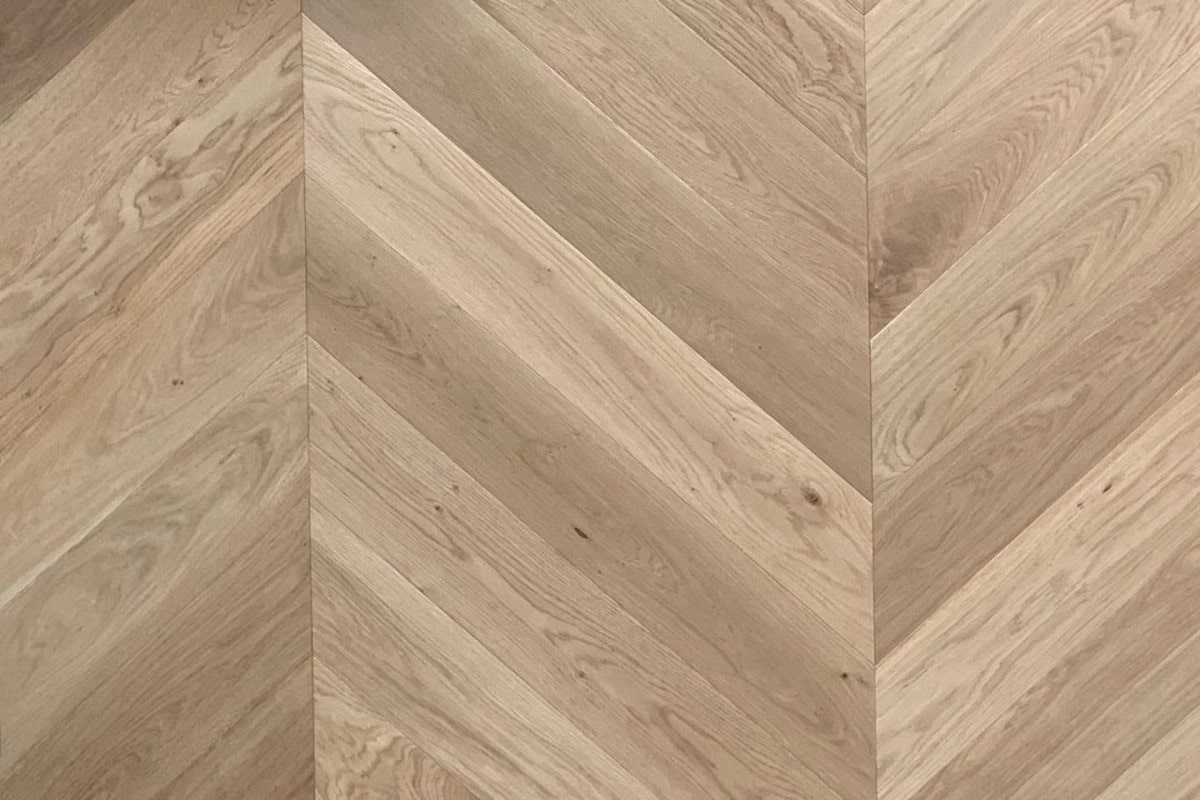
Chevron uses boards cut at an angle at each end, usually forty-five degrees, laid point to point so they form continuous unbroken V shapes running down the room. Every board meets its neighbour end to end at the apex.
The practical differences follow from that:
| Herringbone | Chevron | |
| Board ends | Square cut | Angle cut |
| Visual effect | Broken zigzag, busier | Continuous V, more directional |
| Room effect | Adds texture and movement | Elongates and draws the eye |
| Cost | Generally lower | Higher, angled cuts and more waste |
| Best in | Most rooms, period and modern | Long rooms, hallways, formal spaces |
Quality Flooring’s engineered oak range includes a chevron option giving that classic V shaped parquetry design laid in a zig zag arrangement, alongside our dedicated parquetry range.
Other Parquetry Patterns Worth Knowing
Basketweave arranges blocks in alternating pairs, creating a woven appearance. It reads as more traditional and suits period homes, entry halls and smaller feature areas.
Brick bond lays short boards in a staggered offset, like brickwork. It is the most restrained of the patterns and works well when you want subtle texture without the floor dominating.
Double or triple herringbone uses two or three boards together in each leg of the pattern, scaling the design up for larger rooms where standard herringbone would look busy.
Choosing the Right Scale for Your Room
This is where parquetry projects most often go wrong, and it is entirely avoidable.
Pattern scale needs to suit room size. A small board size in a large open-plan living area creates visual noise, with the pattern repeating so frequently that it reads as texture rather than design. Conversely, a large board size in a compact bathroom or study means you only see two or three repeats, and the pattern never resolves.
As a general guide, larger rooms carry larger board formats and wider patterns comfortably. Smaller rooms suit tighter herringbone or a simple brick bond. If you are unsure, lay out a sample area on the floor before committing. Most people find the pattern reads quite differently at full scale than it does on a showroom display.
Direction matters too. Herringbone can run straight down a room or at forty-five degrees to the walls. Chevron almost always runs along the length of the space, because its whole effect depends on that continuous directional line.
Engineered vs Solid Parquetry
For Melbourne conditions, engineered parquetry is the more practical choice in most homes, and it is what the majority of our clients install.
Solid timber parquetry blocks are individually laid, then sanded and coated on site. The advantages are a genuinely seamless surface and the ability to re-sand multiple times over the floor’s life. The disadvantages are cost, installation time, dust and disruption, and greater sensitivity to seasonal movement.
Engineered parquetry uses a timber wear layer bonded to a stable plywood or composite core, pre-finished at the factory. It arrives ready to walk on, it is considerably more dimensionally stable through Melbourne’s seasonal swings, and the factory coating is typically harder-wearing than a site-applied finish. Our engineered flooring range is finished with seven layers of UV-cured wear-resistant European polyurethane.
The trade-off is sanding life. An engineered board can generally be sanded back fewer times than solid, limited by the thickness of the wear layer. For most homeowners, on a floor that will be recoated rather than fully resanded, that is a limitation they never actually reach.
What Parquetry Installation Involves
Parquetry is not a straight-lay floor and it should not be priced or scheduled like one. Two things drive that.
It is almost always direct glue. Parquetry is bonded to the subfloor rather than floated, because the pattern relies on every piece staying exactly where it was placed. Some installations use direct glue with secret nail for additional hold over a timber substrate. Floating a parquetry floor is generally not appropriate.
That means subfloor preparation is not optional. The slab needs to be level, clean, dry and correctly primed. Any variation transfers straight into the finished floor, and with a geometric pattern, small inconsistencies are far more visible than they would be on a straight lay.
It takes longer and produces more waste. Setting out is the critical stage. An installer establishes a centre line and works outward, because a pattern that starts wrong at one end compounds visibly across the room. Every perimeter piece is individually cut. Chevron in particular generates more waste because of the angled ends.
Expect a parquetry installation to take meaningfully longer than the same area in straight-lay boards, and expect the quote to reflect that. Quality Flooring provides parquetry installation as part of our flooring installation services, including levelling, grinding and plywood installation where the subfloor requires it.
What Parquetry Costs in Melbourne
Parquetry sits above straight-lay flooring on both material and installation, and it is worth understanding why so the quote makes sense.
On materials, parquetry boards are shorter and require more precise milling, and chevron requires angled cutting. On installation, the labour is higher because of setting out, individual cutting and slower laying. Waste allowance is higher than the standard used for straight-lay work.
The variables that move a parquetry quote most are the pattern chosen, the board format, the condition of the subfloor and the complexity of the room shape. A rectangular living room is straightforward. A space with multiple doorways, a hearth, angled walls or a bay window takes considerably more cutting.
Because of that, a per-square-metre figure from a website is close to meaningless for parquetry. An onsite measure is the only way to get a number you can rely on.
Which Timber and Colour to Choose
Parquetry is a strong pattern, so the timber and colour choice does a lot of work in setting the tone.
Light and natural oak keeps the pattern visible without the floor becoming heavy. It suits Scandinavian and contemporary interiors, and it works particularly well in rooms with limited natural light.
Mid and smoked tones give more warmth and make the pattern more prominent. This is the most popular direction in Melbourne at present.
Dark and antique finishes read as formal and traditional. Striking in the right room, but they show dust and fine scratching more readily, and they can make a small space feel smaller.
One practical note: strong grain figure competes with the geometry. If you want the pattern to be the feature, a calmer, more uniform grain generally reads better than a highly figured board.
Is Parquetry Right for Your Home?
Parquetry works especially well in entry halls, formal living and dining rooms, hallways, and any space where you want the floor to make a statement. It suits both period homes, where it is historically appropriate, and contemporary builds, where the contrast between a traditional pattern and modern architecture is part of the appeal.
It is less suited to very small or awkwardly shaped rooms, where the pattern cannot resolve and the cutting cost rises sharply. It is also worth thinking carefully about whether you want it running through an entire house or used deliberately in selected rooms. Both approaches work, but they are quite different decisions.
See Parquetry in Person
Parquetry is one of those products that photographs well and looks better in reality. Scale, light and grain all read differently at full size, which is why we would always encourage seeing samples laid out rather than choosing from images.
Visit the Quality Flooring showroom at 423 Warrigal Road, Moorabbin to see our parquetry and chevron ranges, or browse our project gallery to see completed Melbourne installations.
We provide free onsite measurement and quotes, and our installation team handles parquetry projects across Melbourne. Contact us on 03 9532 3850 or at info@qualityflooring.com.au to get started.